


1. The setting
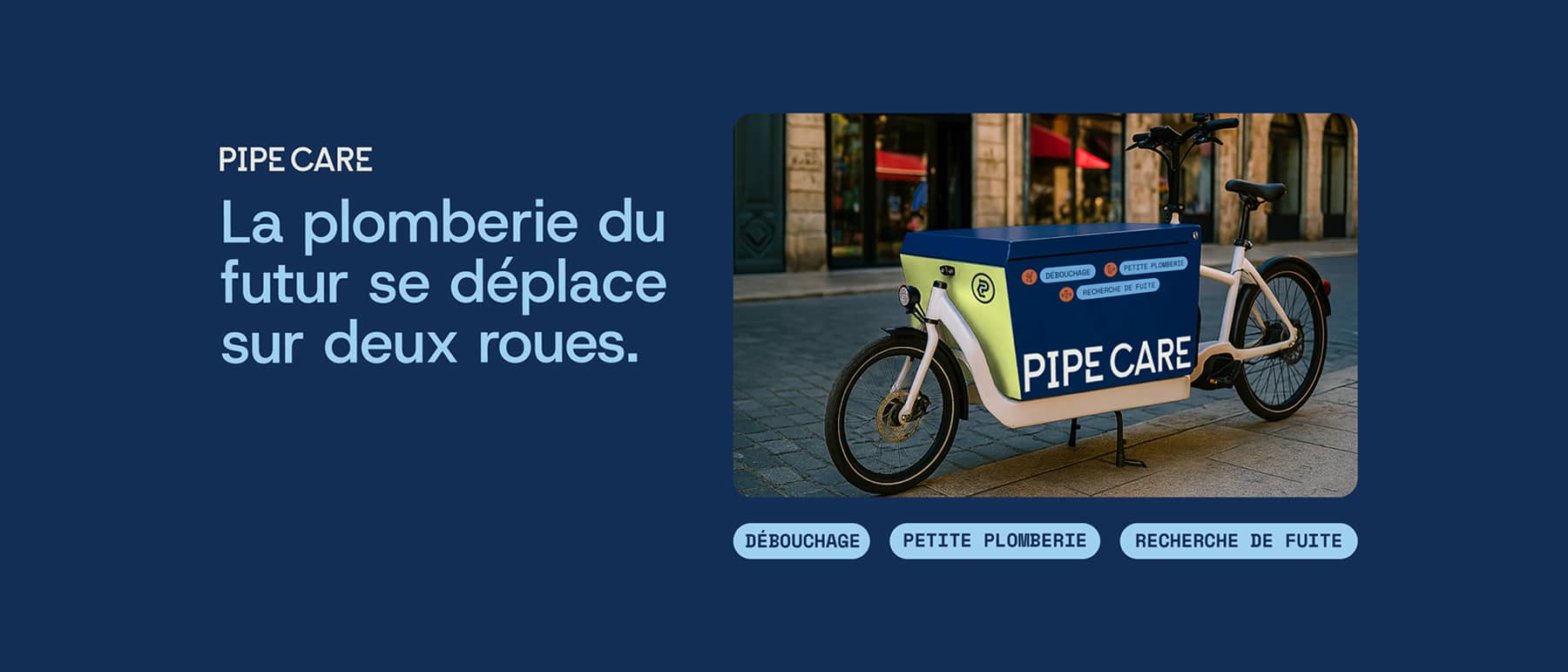
Brussels. A young ex-consultant, a sixty-something veteran from Rigid, and a handful of cargo bikes.
That’s Pipecare in its purest form. Louis had spent years building roadmaps for multinationals at PwC, five years ahead, strategically airtight, without ever tightening a bolt himself.
Then a stint in SME consulting, a year in South Africa putting a tech startup on the map, and finally the question every consultant eventually asks themselves: now that I know how it works, when am I going to do it myself?
The answer didn’t come in a eureka moment, but through Xavier, the father of his partner Charles. A business veteran with the idea of sending plumbers through the city on cargo bikes. Louis heard it and saw more in it than Xavier himself did.
What followed is a story of rapid market validation, tenacious client relationships, and the difference between a business that sounds distinctive and one that truly is.
2. Three F’s and a list of three hundred
How do you start? Louis kept it simple: a list of three hundred property managers and the question of who he knew through mutual contacts. The three F’s (friends, family, fools) didn’t produce much. But the phone did.
Two weeks after launch, Pipecare had booked its first job. Not through a campaign, not through a platform, but through a conversation.
That quick start masks how structural the challenge really is. Because landing a first client and convincing a property manager to switch suppliers are two entirely different exercises. What Louis thought would be a straight line turned out to be a journey with far more friction than the business plan had anticipated.
3. The radical choice for transparency
Before the first client called, Louis had already discovered something unexpected: not a single competitor was able to give him a price for a simple job. Call any drain cleaner in Brussels and ask how much it costs to unblock a sink. You won’t get an answer. Just an “we’ll see when we get there.”
Louis and Xavier called them all. Nobody gave a number. That was the signal.
Inspired by La Compagnie des déboucheurs in France, a company that went from zero to seventy million euros in seven years on transparent flat rates, Pipecare chose to publish its prices on the website. Invoice by email, never on-site. No surprises.
For B2C clients who call already bracing for the worst (“my neighbour got ripped off last week”), it’s a form of reassurance at exactly the moment they need it most. For B2B clients, it’s a signal of administrative reliability: if the quote is already clean, the follow-up will be too.
4. The resistance of the existing relationship
This is where the plan meets reality. Every property manager already has a supplier. Not just one, but ten: because in a large property management firm, it’s not the director who decides, but each of ten employees who each manages twenty buildings. There isn’t one decision-maker. There are ten. And each has their habits, their trusted number on speed dial.
Louis assumed a better client experience would be enough to trigger change. That was too optimistic. The relationship is stronger than rationality. Clients only switch when something goes wrong, not when someone does better.
That demands patience and a prospecting reality much closer to cold calling than content marketing. “The traditional method is still the best,” says Louis, not with nostalgia, but with a quiet realism. Call. Stop by the office. Have a beer. Repeat.
5. Farming and hunting: role allocation as strategy
At Pipecare, everyone has their own cockpit. Xavier is the farmer: he rides through the city every day, knows the streets, knows the names, knows the difference between the sink on the third floor of Rue Véronèse and the one on the second. That proximity has a value no CRM can replace.
Louis structures it: who to call and when, how long between contacts, how to maintain a relationship without wearing it out. Louis and Charles handle the hunting. Cold calling, not their favourite activity, but the necessary fuel for growth. Supplemented by an external freelance prospector who systematically works the B2B segment.
This is not accidental; it’s architecture. Small companies that grow quickly often stumble on exactly this point: everyone does everything, nobody is accountable for what actually works. At Pipecare, the division is deliberate and clear.
6. Acquisition as accelerator
Growing through acquisition is not the Plan B of someone who can’t make it organically. It can also be the Plan A of someone who knows that certain doors only open with a track record you can’t build yourself in two years.
Louis is actively exploring acquisitions in adjacent specialisms. The logic is straightforward: some market segments only become accessible after years of proven service, and that kind of credibility can’t always be built from scratch. Sometimes the smarter move is to find it where it already exists.
The cargo bike stays. The ambition grows.
7. SEO rather than noise
In B2C, the typical client is someone with a blocked sink who opens Google in a panic. That search term, “drain cleaner Brussels,” is the battlefield. Major players dominate Google Ads with budgets Pipecare can’t match, and probably shouldn’t want to match. But in organic search results, space remains.
Radio didn’t work. Flyers didn’t either, and in any case, hard to reconcile with the eco-responsible image. SEO does work. Slowly, steadily, without a single breakthrough moment but with a cumulative effect.
Louis now has a year of data. He knows what works and what doesn’t. Twenty-five thousand euros of marketing budget later, that’s the most valuable output: knowing where to put the next euro.
8. Lessons from the cockpit
- Validating a market is one thing. Converting a client is another. Landing a first client in two weeks is impressive. Replacing a supplier at a property manager who is satisfied with a mediocre provider structurally requires more patience and personal contact than any digital channel can offer.
- Transparency is not a feature; it’s a positioning. In a sector where price opacity is the norm, displaying flat rates is not a marketing trick but a fundamental choice about who you are. This choice attracts the clients who suit you and filters out the rest.
- Role allocation is strategy. Who farms, who hunts, who follows up. In small teams, this clarity disappears quickly. At Pipecare, it is deliberately constructed.
- Acquisition is not always something you can afford to wait for. Certain market segments are only accessible with proven experience. You can build it, or you can buy it. The second option is not a concession; it’s commercial intelligence.
- Healthy growth is also a choice. Louis prefers twenty FTE on solid foundations over a hundred FTE on investor oxygen. In a sector that has sometimes imploded spectacularly, that’s not caution born of fear, but vision born of honesty.
Louis is co-founder of Pipecare, plumbers on cargo bikes in Brussels, specialising in leak detection, drain unblocking, and emergency plumbing. This conversation is part of an ongoing series of cockpit conversations about growth, positioning, and the commercial choices of entrepreneurs in motion.