



Hardware: hard game. Faster game over.
1. The setting
The start-up world is in love with software: sprints, releases, growth hacks. Deploy today, tweak tomorrow. In that scenery, hardware quickly feels old school, slow, expensive and difficult. Until you talk to Ashkan from Exoligamentz. We turn out to have sat in the same school benches in Roeselare, thirty years apart; he as the son of a political refugee from Iran, me as a village boy from Kortemark.
No longer in the classroom, but in the cockpit with one question in the middle: what does it take to stick with physical innovation, one single line, for more than ten years? This conversation is about finger injuries on the mat that end in a patent, about a university where there was no blueprint yet for the student innovator, and about hundreds of prototypes, IOF files, a pandemic and big brands on the line. It is about the difference between having an idea and defending it for ten years against everything that seems faster and easier. Anyone who steps out of this cockpit conversation with just a nice story misses the point. The real point is the question: which part of your business do you dare to make so hard that you can no longer build excuses around it?
2. From “declared dumb” to toughest track
Ashkan finishes primary school with the worst diploma of the class. A teacher pushes him towards vocational education and expectations are low. In that classroom sits his mother, in Belgium since 1991, who defends her son calmly but sharply during the parent-teacher meeting. That image burns in and becomes a silent deal: if she turns her life upside down for his future, he will not burden her with extra worries. Her life as a single parent was hard enough already.
After convincing the headmaster to admit him despite his weak grades, he flips the script in secondary school. Where they say “take less maths”, he chooses the track with the most maths. Not because it is fun, but because he refuses to let anyone decide what he can or cannot handle. That parent-teacher meeting in sixth grade did not become fuel, but a boundary: not to show them that he could do it, but to never again let his mother stand in such a conversation. Her sacrifice did not deserve extra weight.
3. A glove born in the exam period
After secondary school follows veterinary medicine in Ghent: intensive, heavy and a “nuclear attack on your brain”. In parallel, he discovers martial arts such as shootfighting and Brazilian jiu-jitsu. On the mat, his fingers are almost breaking on him due to heavily loaded ligaments, where sports tape proves to be more hassle than solution. He looks at it through the lens of a medically trained fighter and wonders what this does to your hands in the long term.
During a night of cramming virology, the click happens: no more tape, but a soft exoskeleton in the shape of a glove that allows normal movements and minimises abnormal ones. He draws the idea, sends the sketch to himself by registered mail for the date stamp and decides: this is going to be serious work.
4. Student entrepreneur without manual
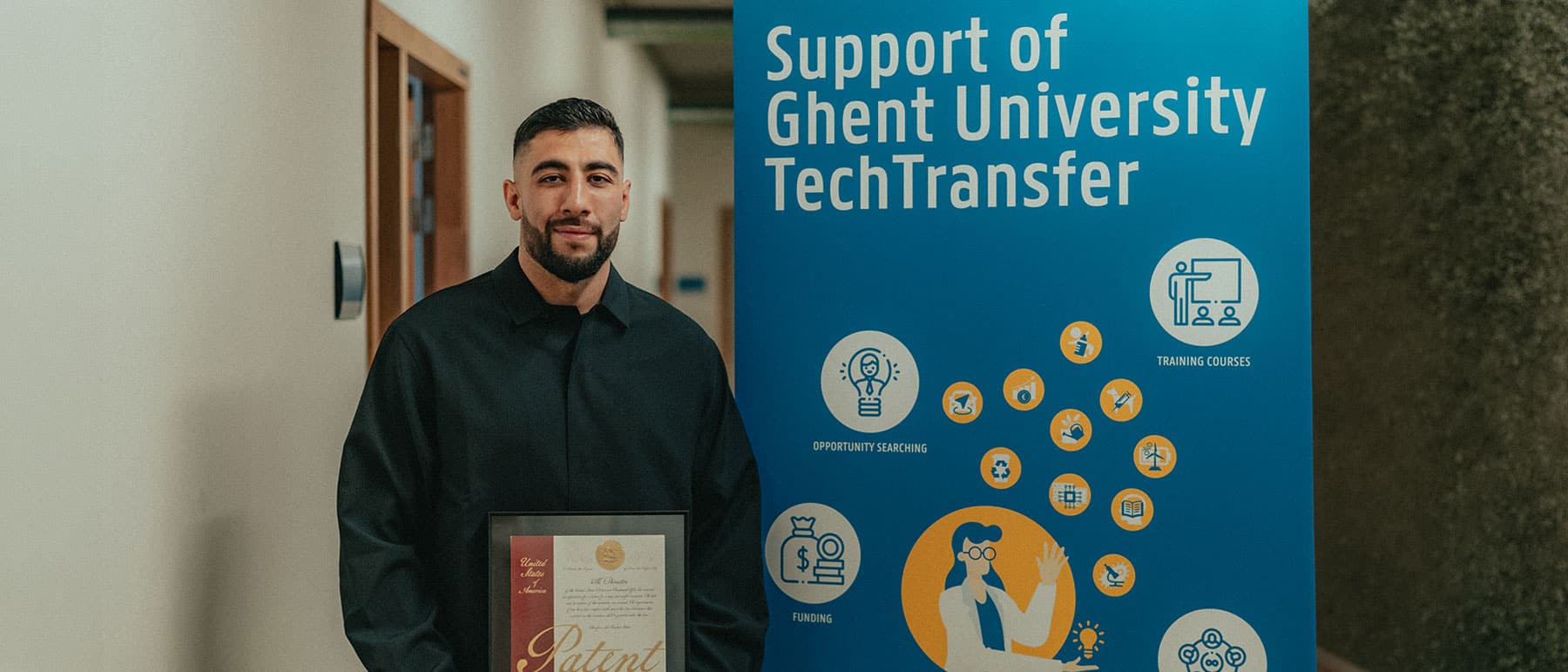
With his student-entrepreneur status, he knocks on the doors of textile engineering and tech transfer. There he discovers that there is a status, but no trajectory for a student who brings his own technical concept and wants to build research around it. After two years, he opens a path himself and develops an IOF file of 100,000 euros with Prof. Lieva Van Langenhove as supervisor.
The first round is rejected, as it was the first time such a research project was submitted from a student idea. Instead of folding, he goes to the vice-rector with the question of whether the rejection is about the content or about the fact that the system is not designed for it. After getting confirmation that they are not against the project, he improves the file. The second round is approved and his case later becomes the manual that did not exist before.
5. Hardware, hard game
After that approval, the real test begins with research, prototypes and choice of materials. He faces factories that do not know rollback and a pandemic that hits just when he wants to accelerate. Where software teams can work in sprints, he works in seasons. Every iteration costs time and money; a mistake is not a new build, but lost lead time and burned budget. Every step forward has to pass through three filters: technically sound, producible and affordable.
For ten years he stays on that one line without pivots to easier products or side projects. The core remains: protect fingers without betraying the sport. Hardware is a hard game, but exactly because of that, it sharpens the entrepreneur who dares to play it.
6. Saying “no” to fast legitimacy
At a certain point, big sports brands start calling. For many founders that is the jackpot because of the logo and reach, but Ashkan pulls the handbrake. The question becomes whether the deal serves his product or mainly their brand. If the balance is off, a quick deal is a shortcut to regret. Better slow and pure than fast and crooked.
These are decisions that never get a LinkedIn post; nobody sees them except you and your mirror. Here hardware shows its sharpness: you can hide less behind a pretty interface. If the glove does not do what it is supposed to do, you feel it immediately.
7. First customers, first confirmation
Ten years after the first sketch, the glove gets its real exam with a version that meets the founder’s minimum requirements. No big launch, but deliberately small. The first dozens of pairs go to athletes who know what finger pain feels like. The feedback is clinically clear: athletes notice that finger joints stay more supple and train for the first time in years without pain. There, in the silence after training, ten years of trajectory becomes concrete; not in a press release, but in a hand that still fully works.
8. Lessons from the cockpit
- Harsher context, sharper choices: Hardware forgives less, which forces entrepreneurs to be sharper about where time and money go, and forces them to sell only what really fits the customer.
- No framework? Design it: Ashkan did not wait for the perfect programme for student innovators but wrote it himself. Entrepreneurs should not wait for market readiness but set their own rules of the game.
- One idea, a very long breath: Building one product for ten years is concentration, not slowness. Entrepreneurship goes far beyond features; it is about the trajectory.
- Saying “no” as a power move: Consciously saying no to big names protects your product, brand and margins, which builds trust both internally and externally.
- Reality over presentation: Real validation is not in slide decks but in use. Users who stay are the ultimate sanity check for entrepreneurs.

Want a conversation like this?
Every cockpit conversation is a real talk with a founder or owner manager about the choices that shape their growth. Curious what a conversation like this could do for your business?