


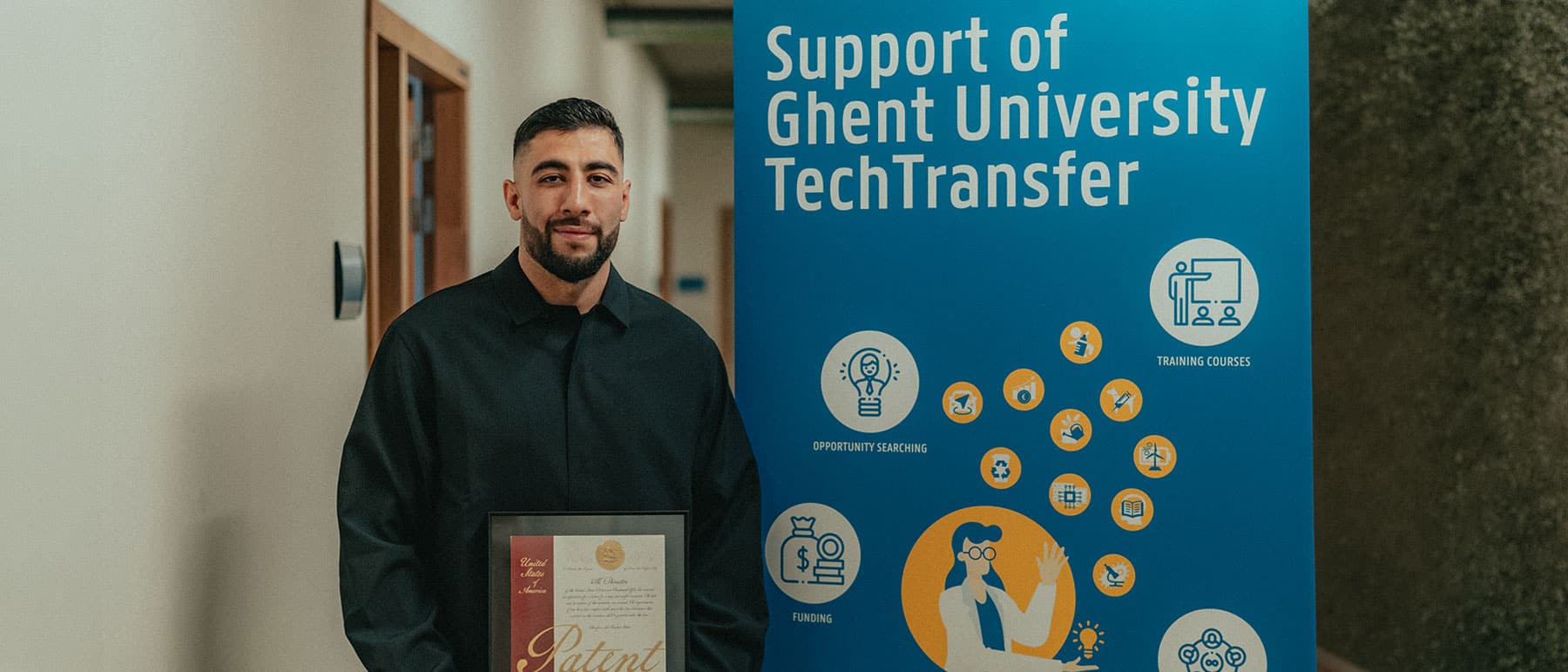
In de cockpit met Ashkan (Exoligamentz)
Hardware: hard game. Faster game over.
1. The setting
The start-up world is in love with software: sprints, releases, growth hacks. Deploy today, tweak tomorrow. In that scenery, hardware quickly feels old school, slow, expensive and difficult. Until you talk to Ashkan from Exoligamentz. We turn out to have sat in the same school benches in Roeselare, thirty years apart; he as the son of a political refugee from Iran, me as a village boy from Kortemark.
No longer in the classroom, but in the cockpit with one question in the middle: what does it take to stick with physical innovation, one single line, for more than ten years? This conversation is about finger injuries on the mat that end in a patent, about a university where there was no blueprint yet for the student innovator, and about hundreds of prototypes, IOF files, a pandemic and big brands on the line. It is about the difference between having an idea and defending it for ten years against everything that seems faster and easier. Anyone who steps out of this cockpit conversation with just a nice story misses the point. The real point is the question: which part of your business do you dare to make so hard that you can no longer build excuses around it?
2. From “declared dumb” to toughest track
Ashkan finishes primary school with the worst diploma of the class. A teacher pushes him towards vocational education and expectations are low. In that classroom sits his mother, in Belgium since 1991, who defends her son calmly but sharply during the parent-teacher meeting. That image burns in and becomes a silent deal: if she turns her life upside down for his future, he will not burden her with extra worries. Her life as a single parent was hard enough already.
After convincing the headmaster to admit him despite his weak grades, he flips the script in secondary school. Where they say “take less maths”, he chooses the track with the most maths. Not because it is fun, but because he refuses to let anyone decide what he can or cannot handle. That parent-teacher meeting in sixth grade did not become fuel, but a boundary: not to show them that he could do it, but to never again let his mother stand in such a conversation. Her sacrifice did not deserve extra weight.
3. A glove born in the exam period
After secondary school follows veterinary medicine in Ghent: intensive, heavy and a “nuclear attack on your brain”. In parallel, he discovers martial arts such as shootfighting and Brazilian jiu-jitsu. On the mat, his fingers are almost breaking on him due to heavily loaded ligaments, where sports tape proves to be more hassle than solution. He looks at it through the lens of a medically trained fighter and wonders what this does to your hands in the long term.
During a night of cramming virology, the click happens: no more tape, but a soft exoskeleton in the shape of a glove that allows normal movements and minimises abnormal ones. He draws the idea, sends the sketch to himself by registered mail for the date stamp and decides: this is going to be serious work.
4. Student entrepreneur without manual
With his student-entrepreneur status, he knocks on the doors of textile engineering and tech transfer. There he discovers that there is a status, but no trajectory for a student who brings his own technical concept and wants to build research around it. After two years, he opens a path himself and develops an IOF file of 100,000 euros with Prof. Lieva Van Langenhove as supervisor.
The first round is rejected, as it was the first time such a research project was submitted from a student idea. Instead of folding, he goes to the vice-rector with the question of whether the rejection is about the content or about the fact that the system is not designed for it. After getting confirmation that they are not against the project, he improves the file. The second round is approved and his case later becomes the manual that did not exist before.
5. Hardware, hard game
After that approval, the real test begins with research, prototypes and choice of materials. He faces factories that do not know rollback and a pandemic that hits just when he wants to accelerate. Where software teams can work in sprints, he works in seasons. Every iteration costs time and money; a mistake is not a new build, but lost lead time and burned budget. Every step forward has to pass through three filters: technically sound, producible and affordable.
For ten years he stays on that one line without pivots to easier products or side projects. The core remains: protect fingers without betraying the sport. Hardware is a hard game, but exactly because of that, it sharpens the entrepreneur who dares to play it.
6. Saying “no” to fast legitimacy
At a certain point, big sports brands start calling. For many founders that is the jackpot because of the logo and reach, but Ashkan pulls the handbrake. The question becomes whether the deal serves his product or mainly their brand. If the balance is off, a quick deal is a shortcut to regret. Better slow and pure than fast and crooked.
These are decisions that never get a LinkedIn post; nobody sees them except you and your mirror. Here hardware shows its sharpness: you can hide less behind a pretty interface. If the glove does not do what it is supposed to do, you feel it immediately.
7. First customers, first confirmation
Ten years after the first sketch, the glove gets its real exam with a version that meets the founder’s minimum requirements. No big launch, but deliberately small. The first dozens of pairs go to athletes who know what finger pain feels like. The feedback is clinically clear: athletes notice that finger joints stay more supple and train for the first time in years without pain. There, in the silence after training, ten years of trajectory becomes concrete; not in a press release, but in a hand that still fully works.
8. Lessons from the cockpit
- Harsher context, sharper choices: Hardware forgives less, which forces entrepreneurs to be sharper about where time and money go, and forces them to sell only what really fits the customer.
- No framework? Design it: Ashkan did not wait for the perfect programme for student innovators but wrote it himself. Entrepreneurs should not wait for market readiness but set their own rules of the game.
- One idea, a very long breath: Building one product for ten years is concentration, not slowness. Entrepreneurship goes far beyond features; it is about the trajectory.
- Saying “no” as a power move: Consciously saying no to big names protects your product, brand and margins, which builds trust both internally and externally.
- Reality over presentation: Real validation is not in slide decks but in use. Users who stay are the ultimate sanity check for entrepreneurs.


LinkedIn is good for my ego. Postcards are better for my conversations.
The paradox: high reach, little movement
You post on LinkedIn. The views go up. You get likes, “nice post”, “relatable”. And then you check your calendar. No extra conversation.
The more visible you become online, the more invisible you seem to the people who really matter. Your ideal clients live around the corner, sit in your ecosystem, are friends with your current clients. While you dive into your content calendar, they simply scroll past your post among hundreds of others, when they actually just want to talk to someone.
This piece isn’t about “how to game the algorithm better”. It’s about two other questions: why should LinkedIn be the heart of your client development in the first place? And why does being visible in the feed feel safer than directly approaching someone?
The fear beneath all that content
You don’t just post because it’s efficient. You also post because it feels safer than actually approaching someone. Direct contact feels vulnerable:
- you can get a clear no
- you show that you need new clients
- you’re afraid of coming across as pushy
- you can be personally rejected
LinkedIn feels more comfortable. You throw something out into the world. If nobody responds, it’s “the algorithm”. No no, no yes, no conversation. Just noise.
In cockpit conversations with entrepreneurs, directors and partners, I see the same pattern: they hide commercial doubt behind content activity. Busy doing. Little movement. I did the same for years myself, until I had to honestly admit: my best clients never came through the feed. They came because someone dropped my name in a real conversation. (Neyrinck 2025)
What research has been saying for a long time (and you unconsciously confirm)
Mark Granovetter showed back in 1973 that new opportunities rarely come through your inner circle, but through weak ties: acquaintances, friends of friends, people one or two steps removed (Granovetter 1973). Recent work by Rajkumar and colleagues based on a large-scale LinkedIn experiment confirms that especially “moderately weak” ties generate new jobs and opportunities (Rajkumar et al. 2022). Morgan and Hunt showed in the mid-90s that sustainable business relationships are built on trust and commitment, not on one clever line in a campaign (Morgan & Hunt 1994). Wasiluk and Löfsten show that physical and social proximity accelerate that trust: organizations that sit close to each other, geographically and relationally, share knowledge faster, build trust faster and do business faster (Wasiluk 2020; Löfsten 2022).
In summary:
- new opportunities run through weak ties, not through mass reach
- trust grows where people see and hear each other more often
- algorithms can support that, but never replace it
As a commercial copilot, I see exactly the same thing: the trajectories that really matter at Add Business never start with “I saw your LinkedIn post or email”. They start with a name, a warm introduction, a conversation, proximity. (Neyrinck 2025)
The inversion: from feed to people
Most companies play the same game:
- Open LinkedIn
- Collect connections
- Make posts
- Wait for someone to respond
- Hope that “something” comes out of it
My work starts from a different inversion:
- Determine who you really want to work with (DNA-fit, ecosystem, stage).
- Find out through whom you’re already indirectly connected (weak ties, shared context).
- Make direct contact, outside the algorithm.
- Only use LinkedIn after that for verification and follow-up.
In my own practice, I combine DNA-discovery, ecosystem-mapping and weak-ties theory into concrete workflows: who do you choose, why exactly them, and what do you write to them in a way that’s both human and sharp. This isn’t a theoretical exercise, but something I’ve refined over years in real client trajectories. (Neyrinck 2025)
The 1-2-3 method: from offline signal to real conversation
To make that structural, I work with a simple rhythm: 1-2-3.
- a postcard with a personal, handwritten letter.
- a LinkedIn connection with a soft request for contact
- a phone or live conversation.
That’s all there is to it. But you do it consistently.
- 3 to 5 postcards per week, depending on how busy my consultancy work is
- in approximately 25 to 30 active weeks per year
- good for about 75 to 100 very deliberately chosen contact moments
Not to “the market”. To 75 to 100 people of whom you know in advance: if a number of these get into conversation, it changes my year. And the contacts will undoubtedly be “enriching”, regardless of the outcome.
Research on direct mail shows that physical, personal messages are almost always opened and stick much better than emails (Scribe Handwritten 2025; Letter Friend 2026). The card is your first, tangible signal that you’re taking the initiative, not the algorithm.
As an alternative or addition, you can apply the same principle with something else that breaks through the noise:
- a short, handwritten letter in a regular envelope
- a small, meaningful artifact (for example, a cockpit card with your notes on it)
As long as it’s personal, handwritten and clearly for them, it works.
LinkedIn connection with intention
A few days later, you send a personal connection request on LinkedIn:
- reference to your card (“I sent you a card last week…”)
- a brief explanation of why you’d like to connect
- no pitch, no pressure, no “book here”
LinkedIn doesn’t become a lead generation engine here, but a verification screen. Whoever types in your name sees your profile, your blogs, your cases. What was in your card matches what they see online. (LinkedIn Algorithm Report 2025; Neyrinck 2025)
The conversation
The third step is the conversation. That can be a phone call, a Teams call or a coffee.
Your goal isn’t “selling in 30 minutes”, but a cockpit conversation:
- what’s really going on in their commercial reality?
- what paradoxes do they feel between growth, team and structure?
- where can a commercial copilot help in the cockpit — and where not?
With 3 to 5 cards per week, a rhythm emerges of a small but stable number of first conversations and a subset of second and third conversations with real depth
Sources
- Granovetter, Mark S. 1973. “The Strength of Weak Ties.” American Journal of Sociology 78 (6): 1360-1380.
- LinkedIn Algorithm Report. 2025. “Your LinkedIn Reach Is Down 40%. Here’s Why—and What’s Next.”
- Letter Friend. 2026. “Handwritten Direct Mail Response Rates: Analyzing the Psychology.”
- Löfsten, Hans. 2022. “Entrepreneurial Networks, Geographical Proximity, and Their Effects on Firm Growth.” Journal of Small Business Management 60 (6): 1234-1256.
- Morgan, Robert M., and Shelby D. Hunt. 1994. “The Commitment-Trust Theory of Relationship Marketing.” Journal of Marketing 58 (3): 20-38.
- Rajkumar, Karthik, Guillaume Saint-Jacques, Iavor Bojinov, Erik Brynjolfsson, and Sinan Aral. 2022. “A Causal Test of the Strength of Weak Ties.” Science 377 (6612): 1304-1310.
- Scribe Handwritten. 2025. “Printed vs. Handwritten Direct Marketing ROI.”
- Wasiluk, Agnieszka. 2020. “Inter-Organizational Trust as a Statement of Social Proximity.” Journal of Entrepreneurship, Management and Innovation 16 (3): 67-92.
- Xpert Digital. 2025. “Why Your LinkedIn Success Is a Mathematical Illusion.”
- Neyrinck, Marc. 2025. Internal cockpit notes and blogs on www.addbusiness.be about weak ties, proximity, DNA-fit and commercial resilience.